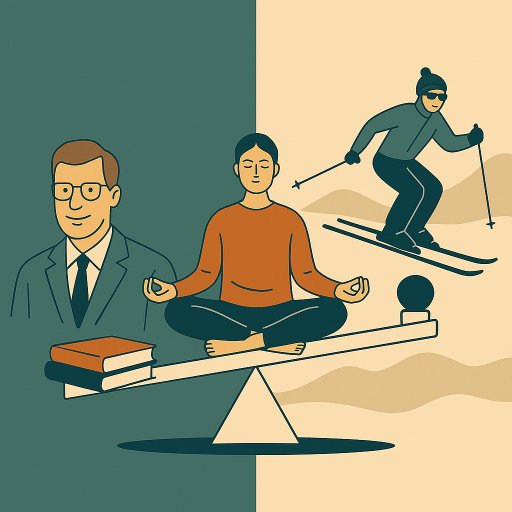
Professional success is not solely dependent on talent and hard work within one’s field of expertise, whether in sports, business, or the arts. More than ever, the pursuit of balance between personal life and work has proven essential for longevity and high performance. Athletes and professionals across various domains understand that caring for mental and physical well-being outside of their primary responsibilities directly impacts results. One remarkable example in sports is tennis legend Roger Federer, who has always prioritized time with his family and hobbies like skiing. In an interview with SWI in June 2023, Federer shared that skiing with his children was a dream come true and that time away from the courts helped him maintain a balanced mindset and renewed motivation. Similarly, in soccer, Kaká highlighted in his book Toward the Goal (2010) how reading became a vital tool for relieving the pressures of the game and keeping his mind sharp beyond training sessions.
Beyond the realm of sports, renowned business leaders and creatives also adopt this approach. Bill Gates, for instance, reflected in his book Source Code (2025) on the importance of setting aside time for reading and contemplation away from corporate demands, allowing for greater creativity and sound decision-making over the years. High-performing professionals recognize that excessive work can compromise creativity and even decrease productivity in the long run.
The concept of “fair play” should not be limited to sports. In the workplace, setting healthy boundaries is a way to play fair with oneself. Prioritizing breaks, defining schedules, and respecting moments of leisure are not signs of a lack of commitment but rather strategies to ensure sustainable performance. A study conducted by the University of Auckland in 2008 analyzed the impact of work-life balance among students and professionals, concluding that those who engage in extracurricular activities exhibit higher productivity and well-being. Additionally, a systematic review published by SciELO Brasil in 2021 found that the absence of a healthy work environment negatively affects the well-being of higher education professionals.
Engaging in activities that complement one’s main routine provides the mental rest necessary for focus and innovation. Whether through artistic pursuits, hobbies, or moments of introspection, the key is to understand that success is built not only on hard work but also on emotional intelligence and self-care. In sports, business, and life, balancing effort and recovery is the foundation for longevity and high performance.
 Synergetic Mindset
Leave a comment